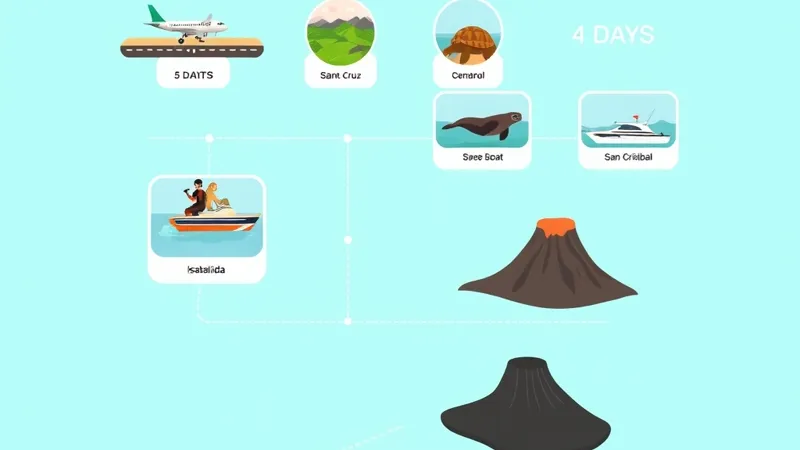
Is 4 days enough for a Galápagos land tour, or do you need 5?
A 4-day land tour realistically gives you about two full activity days plus two half days — arrival and departure — and it works best if you stay on one or two islands, typically Santa Cruz plus San Cristóbal. A 5-day tour adds one genuine full day, and that single day is what makes a third island (usually Isabela) or a full-day boat excursion possible without spending most of your time in transit.
Neither length can guarantee specific wildlife or specific visitor sites. Landing points and visitor sites are allocated under Galápagos National Park Directorate rules and can be modified for conservation, sea conditions or maintenance; the archipelago is a UNESCO World Heritage site and access is managed accordingly. Giant tortoises, marine iguanas, sea lions and blue-footed boobies are frequent but never guaranteed, and no operator can promise a sighting.
The practical rule: choose 4 days if Galápagos is one leg of a longer Ecuador trip and you want a single base with beaches and snorkelling. Choose 5 if you want a volcano hiking day, a second boat day, or a buffer against a cancelled crossing.
How many usable days do you actually get on a 4-day versus a 5-day itinerary?
Fewer than the title suggests — tour names count calendar days, not activity days. Mainland flights from Quito or Guayaquil to Baltra (GPS) and San Cristóbal (SCY) depart in the morning and arrive late morning to early afternoon, and return flights leave mid-morning to early afternoon. Both the first and last day are therefore partial, whichever length you book.
Transfers eat into what remains. Baltra airport to Puerto Ayora takes 45–60 minutes by road, including the Itabaca Channel crossing. San Cristóbal airport sits about 10 minutes from Puerto Baquerizo Moreno.
| Tour length | Full activity days | Partial days | Nights on the islands |
|---|---|---|---|
| 4 days | ~2 | 2 (arrival + departure) | 3 |
| 5 days | ~3 | 2 (arrival + departure) | 4 |
One extra night raises usable full days by about 50%. That is the single most important number in this comparison. Confirm current flight times directly on the airline schedule pages (Avianca, LATAM Ecuador) and check entry requirements with the Ecuador Ministry of Tourism before you commit to a tight connection.
How long does it take to travel between the inhabited islands by speedboat?
About two to two and a half hours per crossing, and every crossing costs you roughly half a day in practice. Santa Cruz to San Cristóbal takes about 2 to 2.5 hours. Santa Cruz to Isabela takes about the same. There is no direct public speedboat between San Cristóbal and Isabela: Puerto Ayora is the hub, so moving between those two islands means a connection and, realistically, a whole day.
Public speedboats conventionally run twice daily, early morning and early afternoon. One-way tickets are paid in US dollars, and a water-taxi fee applies at each port to get you between the dock and the boat.
The half-day figure is not just sailing time. Add arrival at the pier, luggage handling, the water taxi, and the mandatory baggage inspection carried out by the Galápagos Biosecurity Agency (ABG) to prevent the movement of species between islands. Two island changes on a 4-day tour will consume most of your activity time.
What can you realistically cover in 4 days on Santa Cruz and San Cristóbal?
One island plus day trips, or two islands with a single transfer — not three. A Santa Cruz base typically combines the highlands (the Los Gemelos sinkholes, a tortoise reserve, lava tunnels), Tortuga Bay via the 2.5 km paved trail from Puerto Ayora — about 45 minutes on foot — and one boat-based day.
San Cristóbal offers a different profile: the Interpretation Centre, the Cerro Tijeretas trail above town, and boat excursions toward Kicker Rock (León Dormido), a tuff cone rising steeply from the sea about an hour by boat from port.
None of this is a fixed itinerary. Specific sites are assigned by the National Park, most require a certified naturalist guide, and daily plans are rearranged when sea conditions or park scheduling demand it. Tortoises in the highlands are frequent but never guaranteed; they are wild animals in a protected area.
What does the fifth day actually add to a Galápagos land tour?
One of three things, and you should decide which before booking.
Isabela. The fifth day is what makes the third island viable. Isabela unlocks Sierra Negra, whose caldera is among the largest in the world at roughly 9 x 7 km, with a hiking day of roughly 8–16 km round trip depending on whether the route continues to Volcán Chico.
A second full-day boat excursion. More time on the water usually means more habitats — and therefore a better statistical chance of varied marine sightings, without any promise attached.
A buffer. Weather, swell and rescheduled crossings are ordinary occurrences here, not exceptions.
The trade-off is explicit: if you spend day five on Isabela, more than four hours of it goes to sea transfer. The fifth day is genuinely "net" only if you accept a slower pace. Background on volcanism and species is published by the Charles Darwin Foundation and the Galápagos National Park.
Why can no operator promise specific wildlife sightings or visitor sites?
Because both are governed, not sold. Visitor sites in the Galápagos National Park are allocated through authorised itineraries and quotas, most sites require a certified naturalist guide, and access can be modified at short notice for conservation, sea state or maintenance. An operator can tell you what a tour normally includes; it cannot guarantee a specific islet, landing point or exact sequence.
Wildlife is wild. Breeding, moulting and feeding cycles shift by season and by year. Giant tortoises, marine iguanas, sea lions, blue-footed boobies, penguins, sharks and rays are frequent but never guaranteed, on a 4-day and a 5-day tour alike.
For scale, the National Park recorded 279,277 visitors in 2024 against 329,475 in 2023. That is context on how managed access works, not a forecast.
Applied to the length question: more days mean more habitats visited and a higher statistical chance of variety. They do not create a guarantee, and any operator claiming otherwise is overselling.
How do season and sea conditions change the 4-day versus 5-day decision?
They change the risk of losing a day, which is precisely what the fifth day insures against.
The warm/wet season, roughly December to May, brings air temperatures around 24–31°C and sea temperatures near 24–27°C, with generally calmer crossings and warmer water for snorkelling. The cool/garúa season, roughly June to November, brings air temperatures around 19–26°C, sea temperatures near 19–23°C, overcast skies and stronger swell driven by the Humboldt Current.
The operational consequence is simple. In the windier months, speedboat crossings are rougher and occasionally rescheduled or cancelled. If your plan involves an island change during that period, 5 days is the more defensible choice — a 4-day itinerary has no slack to absorb a lost crossing.
A wetsuit is worth using in the cool season; water is noticeably colder and most operators provide one. Climate normals are published by INAMHI, tide and sea-condition data by INOCAR, and long-run climate datasets by the Charles Darwin Foundation.
What fixed costs and entry requirements apply regardless of trip length?
The mandatory arrival costs are the same whether you book 4 days or 5, and they are paid in US dollars — Ecuador's official currency.
- Galápagos National Park entrance fee: USD 200 per adult and USD 100 for children under 12, paid on arrival at the airport. The fee doubled on 1 August 2024 under Ordinance 001-CGREG; reduced tiers exist for Ecuadorian nationals and Mercosur/CAN citizens. Verified August 2026 — confirm current amounts at galapagos.gob.ec.
- INGALA Transit Control Card: USD 20, bought before departure at the mainland airport.
- Together, roughly USD 220 per adult on landing (verified August 2026, galapagos.gob.ec). Maximum stay is 60 days per year.
- The Itabaca Channel crossing fee on Santa Cruz, water-taxi fees at each port, and mandatory baggage inspection.
One more item that surprises people: flights from mainland Ecuador to the islands are never included in the multi-day land tours this site covers. Budget them separately.
Because the arrival costs are per-person and length-independent, the marginal cost of the fifth day is essentially one more night of accommodation, one more day of excursions and meals. Tour prices appear in the GetYourGuide widgets on each tour page, not in this article. See also the Galápagos Governing Council and the Ministry of Tourism.
Should you fly into Baltra or San Cristóbal for a 4-day or 5-day trip?
San Cristóbal saves time; Baltra saves connections. Baltra serves Santa Cruz and is the natural hub for onward travel to Isabela, but it adds the road transfer with the Itabaca Channel crossing at both ends of the trip. San Cristóbal puts you 10 minutes from Puerto Baquerizo Moreno and saves roughly 1.5–2 hours of transfer over a return trip — a difference that matters disproportionately when you only have two full days.
The underused option is open-jaw: fly in via San Cristóbal and out via Baltra, or the reverse. This removes one full 2–2.5 hour backtracking crossing and effectively buys back half a day. On a 4-day itinerary it is often the single most useful optimisation available, and it costs nothing but a little planning.
Airport information is published by the operators of Seymour/Baltra (Ecogal) and San Cristóbal airport; check schedules on the airline pages directly. Practical routing detail is collected on our getting there page.
Who should choose 4 days, and who should choose 5?
Score yourself against these profiles rather than looking for a verdict.
Choose 4 days if you:
- are combining Galápagos with mainland Ecuador (Quito, the Amazon, the Andes)
- are prone to seasickness and want to minimise speedboat crossings
- are travelling with young children
- mainly want snorkelling and beaches close to a single base
- are travelling in the calmer warm season
Choose 5 days if you:
- want a volcano hiking day on Isabela
- are travelling in the windier June-to-November months
- are making a single long-haul trip you do not expect to repeat
- plan to dive — Divers Alert Network advises a minimum of 18–24 hours between the last dive and flying, which removes most of a short trip's final day
If three or more points in one column apply, that is your answer. Compare the shortlists side by side: 4-day tours and 5-day tours, with live details shown in the widgets on each tour page.
What scheduling errors most often shorten a short land tour?
Almost all of them are timing errors, and all are avoidable.
- Booking an inter-island crossing on the morning of a mainland flight. A delayed or cancelled speedboat becomes a missed flight.
- Underestimating check-in and inspection times at Galápagos airports, where baggage screening is mandatory in both directions.
- Planning a dive on the final full day, ignoring the recommended surface interval before flying.
- Assuming a direct San Cristóbal–Isabela connection exists. It does not; everything routes through Puerto Ayora.
- Leaving the mainland terminal without the transit control card. It is bought before departure, not on arrival.
Two habits fix most of this: keep your last night on the island you fly out from, and leave a clear buffer between the final excursion and the flight home. On a 4-day tour that buffer is not a luxury — it is the difference between a calm departure and losing the trip's last activity.
How does a 4-day or 5-day land tour compare with a cruise of the same length?
They solve different problems. Cruises sail overnight and can reach uninhabited islands, so a 4-day cruise physically covers more remote sites than a 4-day land tour — that is the format's real advantage. Land-based tours keep you on the inhabited islands with hotel comfort, flexible meals, evenings in town and no night sailing, which suits light sleepers, families and anyone who dislikes being confined to a boat.
Money also flows differently: land tours put a larger share of your spending into hotels, restaurants, guides and boat operators based on Santa Cruz, San Cristóbal and Isabela.
This site covers land-based travel only, so treat the comparison as a way to self-select rather than a recommendation. If you are still deciding on format, read the cruise vs land-based comparison before you look at any specific itinerary length.
Frequently asked questions about 4-day and 5-day Galápagos land tours
Is 4 days too short for the Galápagos?
No, but it is tight. Four days gives about two full activity days plus two half days. It works well as one island with day trips, or two islands with a single transfer. It becomes frustrating if you try to fit three islands in, because each island change consumes roughly half a day.
How many islands can I visit in 5 days?
Realistically two comfortably, or three at a brisk pace — usually Santa Cruz, San Cristóbal and Isabela. Three islands in five days means two speedboat crossings of 2 to 2.5 hours each, so a significant part of your added day goes to transit rather than activities.
Can I see giant tortoises in 4 days?
Frequent, but never guaranteed. Highland tortoise reserves on Santa Cruz and breeding centres on San Cristóbal and Isabela are standard inclusions on short itineraries, and tortoises are seen there often. They are wild animals in a protected area, so no operator can promise a sighting.
How long is the speedboat from Santa Cruz to Isabela?
About 2 to 2.5 hours each way. Public speedboats conventionally run twice daily, early morning and early afternoon. Add time for the water taxi at each port and for mandatory baggage inspection, which is why the crossing effectively costs half a day.
Can I do Sierra Negra on a 4-day tour?
In practice, no. Reaching Isabela requires a 2 to 2.5 hour crossing each way, and the Sierra Negra hike is a full-day commitment of roughly 8–16 km round trip. Fitting both into four days would leave almost no time for anything else.
Do I need a guide for every activity?
Not for everything, but for most protected visitor sites yes. A certified naturalist guide is required at the majority of National Park sites. Town beaches, some marked trails near the ports and Tortuga Bay's public access are exceptions. Requirements are set by the National Park and can change.
Is 5 days enough to include diving?
It can be, with careful sequencing. Divers Alert Network advises a minimum of 18–24 hours between the last dive and flying, so your final dive must fall well before departure day. On a five-day trip that usually means diving on day two or three, not on the last full day.
What happens if a ferry is cancelled?
Crossings are occasionally rescheduled or cancelled for sea conditions, more often in the cool season. Operators normally rebook you on the next departure, which can push your plan back by half a day or more. This is the main argument for building a buffer day into any island-hopping plan.
Can I extend a 4-day tour to 5 once I arrive?
Sometimes, but do not count on it. Hotel availability, boat capacity and guide assignments are limited, particularly in high season, and the mainland flight is a separate booking with its own change rules. Deciding on length before you book is far cheaper than adjusting on the ground.
Which month has the calmest crossings?
The warm/wet season, roughly December to May, generally brings calmer seas and warmer water. The cool/garúa season, roughly June to November, brings stronger swell driven by the Humboldt Current. Conditions vary year to year, so check forecasts and INOCAR sea data close to travel.
Do I pay the park fee on arrival or in advance?
The National Park entrance fee is paid on arrival at the Galápagos airport: USD 200 per adult and USD 100 for children under 12 (verified August 2026, galapagos.gob.ec). The USD 20 INGALA transit control card is bought before departure at the mainland airport. Both are in US dollars.
Is snorkelling possible year-round?
Yes. Snorkelling runs all year on both 4-day and 5-day trips. Water is warmer and visibility often better in the warm season; in the cool season a wetsuit is worth using, and swell can occasionally affect which sites boats are able to reach on a given day.
Sources and further reading
All fees, schedules and access rules should be confirmed on the official pages before you travel. Fee figures in this article were verified in August 2026.
- Dirección del Parque Nacional Galápagos — visitor site rules, guide requirements, entrance fees and visitor statistics.
- Consejo de Gobierno del Régimen Especial de Galápagos — INGALA Transit Control Card and Ordinance 001-CGREG.
- Ministerio de Turismo del Ecuador — entry requirements and tourism regulation.
- Observatorio de Turismo de Galápagos — visitor statistics and length-of-stay data.
- UNESCO World Heritage Centre — Galápagos Islands — conservation status and site management.
- Charles Darwin Foundation — species, breeding cycles and long-run climate datasets.
- INOCAR — tide tables and sea conditions.
- INAMHI — Ecuadorian climate normals.
- Agencia de Bioseguridad para Galápagos (ABG) — baggage inspection and biosecurity rules.
- Divers Alert Network — flying-after-diving guidance.
- CDC Travelers' Health — Ecuador — vaccination and health information; consult a medical professional for personal advice.
- UK FCDO travel advice — Ecuador — the Galápagos Islands fall outside every area covered by FCDO travel warnings; mainland transits deserve normal caution, and the FCDO explicitly exempts airside transit at Guayaquil airport while advising against the city itself.
Airport and flight schedule details should be checked directly with the operators of Seymour/Baltra (Ecogal) and San Cristóbal airport, and with Avianca and LATAM Ecuador for current timetables.