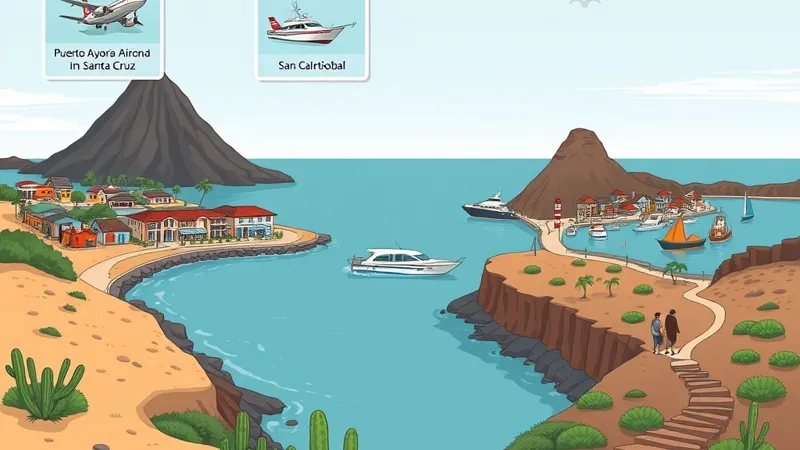
Is Santa Cruz or San Cristobal the better base?
Santa Cruz generally suits travelers prioritizing accommodation, dining and onward island connections; San Cristobal suits those prioritizing a simpler airport arrival and coastal outings around Puerto Baquerizo Moreno. Neither is universally better for a land-based Galapagos trip.
Use this compact comparison to match your travel style:
- Airport access: San Cristobal for fewer transfer stages; Santa Cruz requires a land-and-water connection from Baltra.
- Independent activities: Santa Cruz for Tortuga Bay and research-station visits; San Cristobal for coastal paths and beaches around town.
- Guided excursions: Santa Cruz for neighboring-island natural history outings; San Cristobal for coastal and offshore snorkeling possibilities.
- Hotel location: Puerto Ayora for broader choice; Puerto Baquerizo Moreno for a compact waterfront base.
- Onward transfers: Santa Cruz for island-hopping flexibility; San Cristobal for a stay centered on that island.
Which island has the easier airport transfer?
San Cristobal has the simpler arrival. San Cristobal Airport serves Puerto Baquerizo Moreno directly, with a road transfer rather than an inter-island crossing.
Santa Cruz arrivals use Baltra Airport. The journey continues by airport shuttle, an Itabaca Channel crossing and a road transfer to Puerto Ayora. Driving time alone does not describe the whole transfer: luggage collection, queues and connections add time. Consult Baltra Airport for airport information and confirm onward arrangements before departure.
Choose mainland flights around your intended base rather than automatically selecting Baltra. Arriving near your hotel can avoid an unnecessary crossing. Routes and schedules change; confirm suitable flights before committing to accommodation. Distances and transfer-time estimates are omitted here because they have not been independently verified.
Which island is better for independent walks and wildlife?
Both support independent outings, but San Cristobal concentrates several coastal options around its town. Confirm current opening arrangements and which sections are independently accessible before setting out.
On Santa Cruz, the Tortuga Bay outing starts at the signed trail entrance beyond central Puerto Ayora. Expect a paved approach followed by sand, with exposed stretches. Beach access does not mean every part is suitable for swimming. The Charles Darwin Research Station area is reached from the eastern end of town; check which visitor facilities require tickets or guided entry with the Charles Darwin Foundation.
On San Cristobal, paths around the Interpretation Center and Tijeretas combine coastal vegetation, viewpoints, uneven volcanic surfaces and steps. La Loberia is a separate outing from town, with a road approach and beach terrain. Do not assume entering a coastal area independently also authorizes every snorkeling or offshore activity.
Marine iguanas, sea lions and seabirds may be encountered in coastal habitats. Wildlife sightings are frequent but never guaranteed; no operator can promise them. Follow the Galapagos National Park wildlife-distance rule, keep animals' routes clear and never approach for photographs. Confirm the current numerical minimum and site-specific guide requirements before visiting.
Which island offers the day trips that fit your interests?
Choose excursion categories before choosing a base. Santa Cruz commonly supports neighboring-island natural history excursions, with North Seymour or Bartolome illustrative possibilities. San Cristobal commonly supports coastal and offshore snorkeling outings, with Kicker Rock an illustrative possibility rather than a guaranteed stop.
The National Park assigns visit sites and landing points. No operator can promise a specific site or exact itinerary. Weather, sea conditions and park rules can change activities, and wildlife sightings remain uncertain.
For a practical next step, compare the inclusions in our land-based tour comparison. Its GetYourGuide widgets provide live prices and ratings; neither belongs in a fixed editorial comparison. Galapagos By Land is an independent guide, not a tour operator.
Where should you stay on either island?
A town-based hotel is usually the simplest option for early departures and independent evenings. In Puerto Ayora and Puerto Baquerizo Moreno, compare the actual walking route to your departure pier, not just proximity to the waterfront.
Ask about nearby restaurants, evening music, road noise, hills, entrance steps and luggage access. A short-looking route can still be awkward with bags or limited mobility.
A secluded Santa Cruz highlands stay offers a different setting but adds road transfers for pier departures and evenings in Puerto Ayora. Include that transport in your plans.
Use our independent accommodation guides and confirm:
- Air conditioning and reliable hot water, especially in budget rooms.
- Step-free entrances, bathroom access and any lift arrangements.
- Drinking-water refill or supply arrangements.
- Cancellation terms and support if transport disruption delays arrival.
How do speedboat transfers affect your choice?
A transfer adds more than time on the water, so avoid unnecessary crossings. Shared passenger speedboats connect Puerto Ayora and Puerto Baquerizo Moreno, but current operating days and availability require separate confirmation.
Allow for check-in, luggage handling, boarding and any water-taxi connections, not just the main crossing. No crossing-duration estimate is presented here as verified.
Conditions can be rough. Motion-sensitive travelers may prefer a single base; travelers with limited mobility should ask specifically about moving boats, boarding steps and assistance. Confirm luggage limits before booking.
Consult DIRNEA for maritime authority information, while checking service availability with the transport provider. Safety information is not a timetable. For Isabela, confirm the connection rather than assuming every island pair has direct service. Avoid relying on an inter-island boat on the day of an outbound flight.
How do weather and sea conditions differ?
Neither base guarantees sunshine or calm seas. Broadly, the warmer, wetter season brings warmer conditions and intermittent rain; the cooler garua season can bring cloud, mist and cooler water.
Town-level coastal conditions differ from Santa Cruz's higher, often damper highlands. Pack sun protection, a light waterproof layer and footwear suited to wet paths. Ask snorkeling providers about exposure protection appropriate to the excursion and your comfort.
Monthly temperature figures are omitted because comparable station locations and observation periods have not been verified. INAMHI and Charles Darwin Foundation climate records are appropriate research targets. Seasonal averages cannot predict an individual crossing or wildlife encounter.
Which base better suits your budget and practical needs?
Your travel pattern matters more than declaring either island cheaper. Compare airport-transfer stages, hotel location, guided-excursion frequency and additional island crossings.
All money references use USD. Budget for mandatory National Park entry and Transit Control Card costs, checking official requirements before travel. Mainland Ecuador flights are never included in the multi-day land tours this site covers. Consult the Galapagos Government Council for entry and transit-card guidance.
Confirm card acceptance, cash access, connectivity and step-free arrangements with individual providers. Do not assume every small establishment accepts cards or offers dependable internet.
Affiliate disclosure: Galapagos By Land may earn a commission from qualifying bookings through its affiliate widgets. Check tour-page widgets for live figures and read the exclusions before booking.
Should you stay on one island or split your trip?
Choose a single base for a short stay; split a longer stay only when you can absorb a transfer day and departure flexibility.
- Short-stay accommodation example: Spend all nights in Puerto Ayora or Puerto Baquerizo Moreno, with room for independent outings and an optional guided excursion.
- Longer-stay accommodation example: Divide nights between the towns, treating the move as a travel day rather than promising an excursion afterward.
These are overnight-planning examples, not fixed visit itineraries. Arriving on one island and departing from the other can avoid backtracking if suitable flights exist.
Decision checklist: Families prioritizing simple arrivals should consider San Cristobal. Motion-sensitive travelers should minimize crossings. Independent walkers can choose by preferred routes and terrain. Travelers prioritizing guided outings should compare excursion categories before selecting hotels.
What else should travelers know?
Airport geography, flight choices and flexibility matter more than a universal island ranking.
Is Baltra Airport on Santa Cruz?
No. Baltra is a separate island. Reaching Puerto Ayora requires crossing the Itabaca Channel and continuing by road.
Can you visit without a cruise, and is one island enough?
Yes. Santa Cruz and San Cristobal both support hotel-based trips. Either island can be enough for a focused stay, but neither provides access to every Galapagos experience.
Can you fly into one island and out of the other?
Potentially. Confirm mainland flights into Baltra or San Cristobal and a suitable return from the other airport before booking the rest of the trip.
Should you take a speedboat on your flight day?
Avoid depending on it. Stay on the island serving your departure airport beforehand; Santa Cruz departures still require the transfer to Baltra.
Does either island guarantee wildlife or a particular visit site?
No. Wildlife sightings are never guaranteed. The National Park assigns excursion visit sites and landing points. No operator can promise a specific site or exact itinerary.
Sources
These official links are research targets, not live-verified references. Current access, transport and entry details require confirmation before travel.
- Galapagos National Park: visitor rules, wildlife separation and site management.
- Galapagos Government Council: entry procedures and transit cards.
- Charles Darwin Foundation: visitor information, wildlife and environmental research.
- Baltra Airport: airport logistics.
- DIRNEA: maritime authority information.
Additional research targets are INAMHI for station-based climate records, Ecuador Tourism for destination logistics, and UNESCO's Galapagos listing for conservation context.