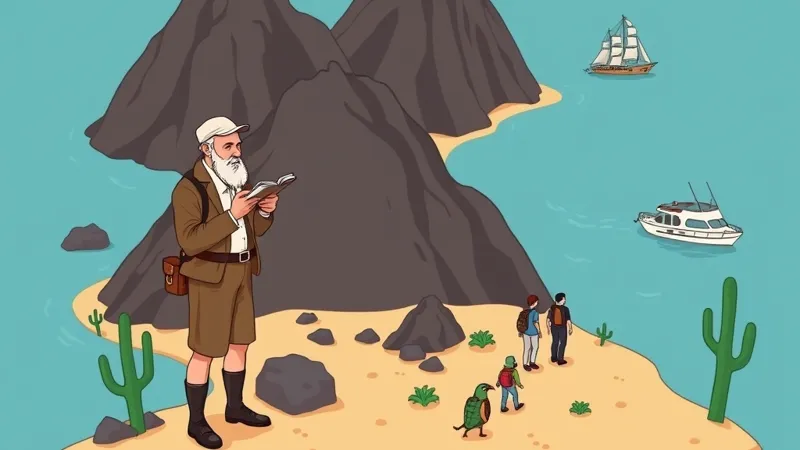
What did Charles Darwin actually do in the Galápagos?
Darwin studied volcanic geology, collected plants and animals, and recorded observations on San Cristóbal, Floreana, Isabela and Santiago during the Beagle expedition. He did not arrive with a finished theory of evolution or discover it in a single moment.
Travelers can explore these islands today, but a modern visitor attraction is not automatically a documented Darwin landing place. Santa Cruz’s Charles Darwin Research Station is a later institution, not his former workplace.
His Beagle diary and Journal of Researches, particularly the diary’s Galápagos entries and the Journal’s chapter “Galapagos Archipelago,” distinguish the expedition’s stay from his individual shore visits. The ship’s movements should not be mistaken for Darwin’s footsteps.
What did Darwin learn from mockingbirds, finches, tortoises and geology?
Island differences became important evidence, but their evolutionary meaning developed after the voyage. Darwin noticed differences among mockingbirds and collected finches whose relationships were clarified by later specialist identification, including John Gould’s work.
Tortoise evidence needs a different attribution: Darwin recorded residents’ claims that they could recognize an animal’s island of origin. That is not equivalent to his independently demonstrating every distinction.
He also examined volcanic rocks, craters and lava formations. These were substantial investigations, not background scenery to the bird story. His Journal’s “Galapagos Archipelago” chapter supplies the primary account; the University of Cambridge’s Darwin Correspondence Project contextualizes the later development of his ideas. On the Origin of Species appeared long after his return. He did not watch evolution unfold during a brief visit.
Which Galápagos islands did Darwin visit?
Darwin landed on San Cristóbal, Floreana, Isabela and Santiago—not Santa Cruz. The diary and Journal distinguish shore investigations from coastal observations made aboard the ship.
- San Cristóbal / Chatham: shore collecting and geological observations around the northeastern landing area. Today’s principal accommodation base lies elsewhere, around Puerto Baquerizo Moreno.
- Floreana / Charles: visits to the inhabited island and cultivated highlands, with information gathered from residents. Modern access generally centers on Puerto Velasco Ibarra.
- Isabela / Albemarle: western shore investigations, including the Tagus Cove area, alongside observations during coastal sailing. Puerto Villamil is not a substitute for those western locations.
- Santiago / James: an extended shore stay around James Bay, with inland exploration. Modern access is through authorized visitor excursions, not a comparable hotel base.
These identifications follow the diary’s island entries and the Journal’s Galápagos chapter. Present-day visitor-site permissions belong to the Galápagos National Park.
Schematic route guide—not to scale:
Historical shore-visit sequence: San Cristóbal → Floreana → Isabela → Santiago. This is not the Beagle’s complete sailing track.
Modern passenger connections: San Cristóbal ↔ Santa Cruz ↔ Isabela. Floreana requires separate service confirmation; Santiago requires an authorized excursion.
The modern network does not reproduce the historical route.
What can you see on San Cristóbal connected with Darwin’s visit?
San Cristóbal combines documented Darwin history with modern interpretation, but these occupy different places. His northeastern landing and fieldwork should not be relocated to the waterfront of Puerto Baquerizo Moreno for convenience.
The interpretation center and Cerro Tijeretas offer historical context, walking and coastal viewpoints accessible from the town area. A monument commemorates Darwin; its presence alone does not establish an exact landing spot.
Use the diary’s Chatham entries for the historical distinction. Check National Park guidance for current trail access, and ask your accommodation about the walk from its actual location. Paths and steps make footwear, heat and mobility more useful planning considerations than an unsupported universal walking time.
How can land-based travelers explore Darwin’s connection with Floreana?
Floreana offers a connection to Darwin’s encounters with settlers and his recorded tortoise information. In the Journal’s “Galapagos Archipelago” chapter, his account of Charles Island discusses the settlement and information supplied by the vice-governor about island differences among tortoises.
A contemporary visit through Puerto Velasco Ibarra and the highlands can provide context, but it does not establish his precise walking route.
Consider an overnight stay or an authorized day excursion where available. Before booking, confirm the departure island, return arrangements, road transfers, walking demands and permitted sites. Post Office Bay is not a routine inclusion on every land-based visit. Its appearance in an itinerary requires explicit confirmation against authorized access.
Can you visit Darwin’s Isabela and Santiago locations without a cruise?
Some relevant visitor sites may be accessible by authorized excursion, but a hotel-based trip cannot be assumed to reach Darwin’s documented locations. His western Isabela activity, described in the diary and Journal, is geographically distinct from the Puerto Villamil area.
On Santiago, ask whether an excursion actually lands on Santiago and which site it visits. Nearby Bartolomé is a separate island; a Bartolomé outing is not automatically a visit to Darwin’s James Bay location.
Visit sites and landing points are assigned by the Galápagos National Park. No operator can promise a specific site or exact itinerary: weather and Park rules decide. Departure ports and excursion availability also vary.
Why visit the Charles Darwin Research Station if Darwin never visited Santa Cruz?
The station represents Darwin’s scientific legacy, not a place where he worked. The Charles Darwin Foundation conducts scientific research; the National Park manages the protected area and associated conservation responsibilities. Their roles should not be conflated.
Visitor interpretation can introduce conservation, ecological research and tortoise recovery work. Public exhibits do not imply access to working laboratories, and research facilities should not be described as unrestricted attractions.
The station lies toward the eastern end of Puerto Ayora’s waterfront road. Walking suitability depends on your hotel and the facilities you intend to visit. Consult Foundation and Park visitor information for opening arrangements and accessible areas rather than relying on a single town-center distance.
How do you travel between Darwin-related islands by speedboat?
Santa Cruz and San Cristóbal are practical hotel bases, with Santa Cruz serving as the usual interchange for other inhabited islands. Baltra Airport is on Baltra, not Santa Cruz: reaching Puerto Ayora requires an airport-side transfer, an Itabaca Channel crossing and onward road transport.
Use this port checklist when comparing tickets:
- Puerto Baquerizo Moreno → Puerto Ayora: a direct inter-island connection when scheduled.
- Puerto Ayora → Puerto Villamil: a direct connection when scheduled.
- Puerto Baquerizo Moreno → Puerto Villamil: generally plan around a Santa Cruz connection, not an assumed direct boat.
- Puerto Ayora → Puerto Velasco Ibarra: confirm the actual passenger service or excursion arrangement before committing to accommodation.
Crossings can be rough. Obtain the expected duration, check-in instructions, baggage requirements and any separate water-taxi boarding steps from the booked service. Consult Ecuador’s official tourism portal and Park visitor and biosecurity guidance. Our arrival and transfer guide explains the wider journey.
How can you plan a land-based itinerary around Darwin’s history?
A week-style trip works best as an interpretation-led stay on San Cristóbal and Santa Cruz, not a claim to retrace every landing. Begin with San Cristóbal’s interpretation visits, transfer to Puerto Ayora, and explore Darwin’s conservation legacy at the station.
Add an authorized excursion only when its departure port and assigned sites fit the route. Extra nights can make Floreana or Isabela more practical, but additional islands consume transfer time. Keep an overnight buffer before an international connection.
All excursions remain subject to availability, weather and Park-assigned sites. Wildlife sightings are frequent but never guaranteed; no operator can promise finches, wild giant tortoises or other animals.
Compare longer land-based itineraries to find a workable balance of history, hotel stays and transfers.
How should you compare Darwin-themed tours and hotels?
Compare access and logistics, not the strength of the Darwin-themed marketing. Galapagos By Land is an independent editorial and affiliate comparison guide, not a tour operator.
Affiliate disclosure: linked tour and hotel pages may contain affiliate booking links; we may earn a commission if you book through them.
Compare departure ports, authorized access, guiding, walking demands, transfers and cancellation terms. Use our hotel guide to assess pier access and route suitability; check hot-water provision in budget rooms. Live prices and ratings belong in GetYourGuide widgets on linked tour pages, not fixed editorial claims.
Budget for mandatory arrival charges separately. Mainland flights from Quito or Guayaquil are never included in the multi-day land tours covered here. Neither branding nor marketing guarantees a historical landing, wildlife encounter or itinerary.
What should travelers know about Darwin in the Galápagos?
The key distinction is between documented history and changing visitor access.
When did Darwin visit, and how long did he stay?
He visited during the Beagle voyage, across parts of September and October. The expedition’s Galápagos stay was longer than his individual shore visits; the diary distinguishes them.
Which islands did Darwin land on, and did he visit Santa Cruz?
He landed on San Cristóbal, Floreana, Isabela and Santiago. He did not land on Santa Cruz, and its research station was never his workplace.
Did Darwin develop his theory of evolution during the visit?
Not as a completed theory. His observations contributed evidence whose significance developed after the voyage, aided by specialist examination of specimens.
Can travelers follow his entire route without a cruise?
Not as a straightforward scheduled island-hopping itinerary. Historical shore locations and modern authorized visitor sites do not consistently coincide.
Are finch or tortoise sightings guaranteed?
No. Wildlife sightings are frequent but never guaranteed, and no operator can promise an encounter.
Sources
Primary accounts support the history; conservation institutions support interpretation and visitor planning.
- Darwin Online: Beagle diary, Galápagos island entries; Journal of Researches, “Galapagos Archipelago” chapter.
- Darwin Correspondence Project, University of Cambridge: correspondence and context for Darwin’s developing evolutionary ideas.
- Charles Darwin Foundation: research, conservation and station visitor information.
- Galápagos National Park: visitor sites, access rules and conservation management.
- UNESCO: Galápagos Islands: the archipelago’s natural heritage and conservation significance.